"I'm not the campaign spokesperson, I'm running the Silicon Valley Leadership Group. That is a full-time job. I'm volunteering with this when I can." Carl Guardino stated for the San Jose Metro on Wednesday as his excuse for not participating in a debate on Measure A scheduled for April 25.
Despite being one of the master planners behind the flawed and dishonest Measure A, Guardino has kept himself behind the scene. On the day when the Supervisors voted to place Measure A on the ballot, Guardino was absent at that meeting. His transportation aide, Laura Stuchinsky, spoke on behalf of SVLG in support of Measure A instead. Recently Stuchinsky temporarily resigned from the VTA's Citizens Advisory Committee to focus on the Measure A campaign.
Back in 2000, while still having a "full-time" job running the SVLG, Carl Guardino was the chief campaign spokesperson for the 2000 Measure A. Why is Guardino refuse to publicly campaign and debate in support of Measure A this time around? Is he afraid to show that he has inconsistent and unfair positions on sales taxes: supporting sales tax exemptions for corporations and sales tax increases for everyone else? Or is he afraid to state his intention of transferring a large portion of the revenue from the sales tax increase to VTA, despite its record of inefficiency and dishonesty, as well as VTA's selection to build wasteful projects like BART at the expense of cost effective Caltrain and local transit improvements?
What else do Carl and SVLG have to hide?
Friday, April 14, 2006


Wednesday, April 05, 2006
VTA proposes to bring shuttle operations in-house
As a new add-on item to the agenda for the VTA board meeting this Thursday, the board will decide whether to amend the labor contract to include a new classification of shuttle bus drivers and mechanics. Members of the Amalgamated Transit Union, which represents VTA's drivers and mechanics, have approved the agreement last week.
Under this agreement, new employee classifications would be created to operate and maintain a fleet of smaller shuttle buses with fewer than 28 seats. These shuttle drivers and mechanics would be paid at a lower wage than the drivers and mechanics of larger buses.
VTA would operate these shuttle buses as a part of the community bus program, to primarily serve outlaying communities and provide connections to mainline bus or light rail service. Currently, VTA runs two community bus routes (48 and 49) in Los Gatos under contract with Parking Company of America, which was ruled last year in violation of the labor agreement with the ATU. If this agreement is approved, VTA is expected to convert these lines into in house operations in the next few months.
In addition, the agreement would also bring light rail shuttle operations in house, including the Great America shuttle, River Oaks shuttle, and the Downtown Area Shuttle. These shuttles are currently contracted to New Century Transportation.
ACE shuttles and shuttles contracted by Caltrain will not be affected.
With the approval of this agreement, VTA would be able to hire 100 to 120 shuttle bus operators. VTA plans to replace standard buses with small buses on low ridership routes, which may include 76, 13, 44, and other feeder routes in the south county. VTA expects a reduction in cost on direct labor as well as fuel, due to the lower fuel consumption of smaller buses.
Under this agreement, new employee classifications would be created to operate and maintain a fleet of smaller shuttle buses with fewer than 28 seats. These shuttle drivers and mechanics would be paid at a lower wage than the drivers and mechanics of larger buses.
VTA would operate these shuttle buses as a part of the community bus program, to primarily serve outlaying communities and provide connections to mainline bus or light rail service. Currently, VTA runs two community bus routes (48 and 49) in Los Gatos under contract with Parking Company of America, which was ruled last year in violation of the labor agreement with the ATU. If this agreement is approved, VTA is expected to convert these lines into in house operations in the next few months.
In addition, the agreement would also bring light rail shuttle operations in house, including the Great America shuttle, River Oaks shuttle, and the Downtown Area Shuttle. These shuttles are currently contracted to New Century Transportation.
ACE shuttles and shuttles contracted by Caltrain will not be affected.
With the approval of this agreement, VTA would be able to hire 100 to 120 shuttle bus operators. VTA plans to replace standard buses with small buses on low ridership routes, which may include 76, 13, 44, and other feeder routes in the south county. VTA expects a reduction in cost on direct labor as well as fuel, due to the lower fuel consumption of smaller buses.
Thursday, March 30, 2006
The Mercury News still doesn't get it
The Mercury News published an editorial today promoting Measure A this June because of the "success" of the 1996 Measure A program, and the fact that the 1996 Measure was passed with 51.8% voter approval.
Essentially, the Mercury News is asserting that the 2/3 voter approval is almost impossible to obtain and therefore the sleazy tactic of selling specific projects as a general tax is justifed.
If we look beyond Santa Clara County, there are good reasons why we should reject this assertion.
Essentially, the Mercury News is asserting that the 2/3 voter approval is almost impossible to obtain and therefore the sleazy tactic of selling specific projects as a general tax is justifed.
If we look beyond Santa Clara County, there are good reasons why we should reject this assertion.
- In November 2003, San Francsico voters approved Proposition K, a 1/2 cent sales tax for transportation, by nearly 75%.
- In November 2004, San Mateo County voters approved Measure A, a 1/2 cent sales tax for transportation, by just over 75%.
- Also in November 2004, Marin County voters passed Measure A, a 1/2 cent salex tax for transportation, by 71%
So the 70% voter approval of the 2000 Measure A in Santa Clara County, during the peak of the high-tech bubble, isn't that quite spectacular or is it?
The major difference between these taxes passed by voters in other counties and ours is that other counties tend to have honest and inclusive discussions about the funding needs and spending priorities. San Mateo County, for instance, held weekend transportation planning workshops around the county to solicit community input. Also, all of these proposals did not include any "marquee" BART extensions that are supposedly poll well (according to SVLG) but would bankrupt the counties.
Santa Clara County, once again, chose a path that limits honest discussions and public participation. Ron Gonzales, Carl Guardino, and Rod Diridon cannot accept themselves being challenged in public on questionable policies. If SVLG and other politicians believe that the county voters will support the idea of the San Jose BART extension be funded at the expense of Caltrain and local transit services, and diverting sales tax revenue from the north and south county to downtown San Jose, Santa Clara County should have taken the "high road." Santa Clara County does not have to create a smokescreen by blurring specific projects with a general tax and create confusion among voters, as a way to get around the 2/3 voter approval requirement.
Friday, March 24, 2006
SVLG operative fails to knock down tax exemption language in the ballot argument
According to the Press Release from the No on Measure A Campaign:
Press Release.
From: Citizens for Sensible Transportation (Committee against Measure A)
Topic: Pro-tax lawsuit fails to silence argument.
Specifics:
At 6:10 PM last night, proponents of an additional sales tax filed a lawsuit to strike several sections from the ballot argument against Measure A. The most important of these was an attempt to remove all mention of a tax exemption for the tax proponents.
The findings and proposed deletions were not approved by the court, which did allow some technical revisions, such as updating a bill number.
The authors agree that the correct bill number is SB1291. SB552 was a bill in last year’s session with largely identical wording. Both grant a giant sales tax exemption to manufacturers, and whole pages are word for word the same between the two bills.
The important argument still stands: The Leadership Group is pushing a bill through the legislature to exempt their members from state sales tax, at the same time they are promoting a sales tax increase in Measure A. The net effect would be that average citizens pay 8.75% sales tax, while manufacturers and big business pay only 2.75%.
These bills, sponsored by Elaine Alquist, contain numerous special interest provisions, such as whole paragraphs that provide a million dollar tax cut for Calpine’s new power plant.
Greg Perry
On behalf of Citizens for Sensible Transportation, the grass roots campaign against measure A.
Press Release.
From: Citizens for Sensible Transportation (Committee against Measure A)
Topic: Pro-tax lawsuit fails to silence argument.
Specifics:
At 6:10 PM last night, proponents of an additional sales tax filed a lawsuit to strike several sections from the ballot argument against Measure A. The most important of these was an attempt to remove all mention of a tax exemption for the tax proponents.
The findings and proposed deletions were not approved by the court, which did allow some technical revisions, such as updating a bill number.
The authors agree that the correct bill number is SB1291. SB552 was a bill in last year’s session with largely identical wording. Both grant a giant sales tax exemption to manufacturers, and whole pages are word for word the same between the two bills.
The important argument still stands: The Leadership Group is pushing a bill through the legislature to exempt their members from state sales tax, at the same time they are promoting a sales tax increase in Measure A. The net effect would be that average citizens pay 8.75% sales tax, while manufacturers and big business pay only 2.75%.
These bills, sponsored by Elaine Alquist, contain numerous special interest provisions, such as whole paragraphs that provide a million dollar tax cut for Calpine’s new power plant.
Greg Perry
On behalf of Citizens for Sensible Transportation, the grass roots campaign against measure A.
SVLG operative files suit to hide its SB552 involvement

Click on the image for larger size
Yesterday, a petition was filed against the authors of the ballot argument against Measure A, which include Greg Perry, in an attempt to try to change or delete sections of the ballot argument. The petitioner, Rick Callender, who is the Government Relations Manager for the Santa Clara Valley Water District and also the head of the Silicon Valley NAACP, filed the law suit as an individual. Callender is claiming that the No on A argument contain five "false or misleading statements of fact." However, most, if not all the complaints against the No on A arguments, are baseless.
The first three so called misleading facts cited by Callender is related to the SVLG's support for SB552 and other sales tax exemption bills through the state legislature. Although SB552 have not granted a hearing since April 2005, supporters of SB552 have continued to lobby for the bill in September, as evidenced by SF Chronicle.
The other tax exemption bills listed by Callender, AB2218 and SB1291, as introduced, would not provide exemption on a local sales taxes. However these bills were presented in late February at about the same time as the county sales tax was being considered. Whether local taxes are exempted or not, SB552, AB2218, and SB2191 would lower the sales tax rate for companies with or without Measure A (less than the current rate of 8.25%), while everyone else would face a higher sales tax burden if Measure A passes (more than 8.25%).
Callender also claims that it is misleading to state that "Santa Clara County will have the highest tax rate in California." Currently, Alameda County, and cities of Alvalon and Richmond have the highest tax rate in the state of 8.75%. If Measure A passes, Santa Clara County will join these jurisdictions of having the highest sales tax rate in California. There is nothing misleading about this statement. If 8.75% is not the highest rate in the state, then what is?
This move to try to mess with the No on A ballot argument is also a sleazy counter-attack to the lawsuit filed on Tuesday by the Howard Jarvis Taxpayers' Assoication against the county, over the timing of the election. HJTA is arguing that the June election doesn't fit the legal definition of the general election, therefore Measure A, a "general" sales tax, cannot appear on this ballot according to Prop. 218.
Gonzales insists that BART will always be his pet project
Despite the censure from the San Jose City Council and his removal from the VTA Board of Directors, SJ Mayor Gonzales presented at the BART extension Policy Advisory Board and participated as one of the PAB members, although his name did not appear on the membership roster.
No one knew why he was there, or knew which government or agency was Gonzales exactly representing.
It will be up to the San Jose City Council to determine whether or not he should be a member of that PAB, but his unexpected move to participate at that meeting is a clear indication that he still sees the BART extension as his pet projects, and wants to be in an influential position for the project as well.
No one knew why he was there, or knew which government or agency was Gonzales exactly representing.
It will be up to the San Jose City Council to determine whether or not he should be a member of that PAB, but his unexpected move to participate at that meeting is a clear indication that he still sees the BART extension as his pet projects, and wants to be in an influential position for the project as well.
Wednesday, March 15, 2006
Flip-flop alert: SVLG wants sales tax exemption for its own members, but wants you to pay more
For many years, despite its preference for backroom deals akin to the Norcal scandal and reluctance to public participation, SVLG has publicly expressed pride for consistently supporting local sales tax increases, including the Measure A this June. On the other hand, SVLG is also sponsoring legislations in Sacramento that would grant sales tax exemptions to corporations, which financially support SVLG.
Senate Bill 552 is one of the few bills supported by SVLG that would provide a permanent sales tax exemption to companies on purchases of certain types of equipment and supplies. The bill would exempt all sales taxes in California, statewide and local. The Senate analysis of the bill states that the local governments across the California would lose $1.1 billion annually, and the state government would lose another $2.1 billion. SVLG claims that SB 552 would make California more competitive for businesses and would keep more jobs in the state.
Whether you agree providing tax exemptions to corporations is a good public policy or not, you should agree that SVLG ought to be consistent with its positions on taxes. Is it okay that large companies don't have to pay sales taxes, while individuals and small businesses face a greater sales tax burden?
Senate Bill 552 is one of the few bills supported by SVLG that would provide a permanent sales tax exemption to companies on purchases of certain types of equipment and supplies. The bill would exempt all sales taxes in California, statewide and local. The Senate analysis of the bill states that the local governments across the California would lose $1.1 billion annually, and the state government would lose another $2.1 billion. SVLG claims that SB 552 would make California more competitive for businesses and would keep more jobs in the state.
Whether you agree providing tax exemptions to corporations is a good public policy or not, you should agree that SVLG ought to be consistent with its positions on taxes. Is it okay that large companies don't have to pay sales taxes, while individuals and small businesses face a greater sales tax burden?
Thursday, March 02, 2006
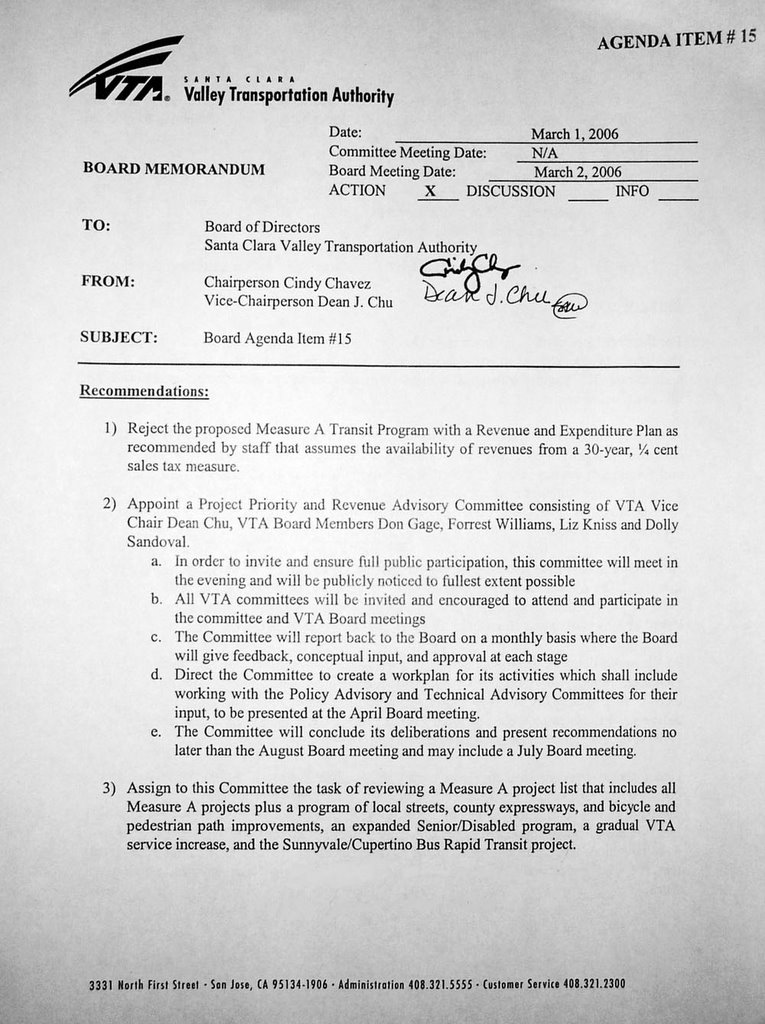
Chavez's first Gonzales-style last minute memo on the proposed VTA expenditure scenario

Click on the images for larger size
At the VTA board meeting on March 2, VTA Chair and San Jose Vice Mayor Cindy Chavez and Dean Chu from Sunnyvale presented a memo to reject the 1/4 cent tax scenario and establish a Measure A sub-commitee to start a "public" process to determine expenditure priorities. The sub-committee would complete its tasks and formulate recommendations to the VTA board no later than August, before the deadline to submit a ballot measure for the November election.
During the discussion, Supervisor Liz Kniss expressed appreciation for the memo and asked to hold the sub-committee meetings in different parts of the county. Supervisor Jim Beall, who is a candidate for the State Assembly, requested to hold one of the meetings in his district as well.
However, Forest Williams from San Jose complained that why he had to wait a few more months to make a decision after spending the last several months discussing the expenditure scenario. He seemed that he wanted to go ahead and immediately vote on the expediture plan despite the disagreements between the cities.
Greg Perry of Mountain View asked why the proposed sub-committee was not charged to study different tax revenue projections and why the members of that sub-committee were designated on the memo rather than letting the city groups to decide.
Dennis Kennedy of Morgan Hill suggested that the sub-committee should recommend an advisory measure at the end of its term in August and submit it for the November ballot.
Despite all the good intentions about public participation and creating a countywide consensus, it was obvious that this memo was produced to avoid a guaranteed divided vote on the 1/4 cent tax scenario, as well as linking the VTA expenditure plan with the June county tax, which could violate Prop. 218. Perhaps what Kennedy was not aware is that he unveiled the plan of Carl Guardino, which is having a general sales tax in June and a following advisory measure in November. It is basically a 1996 A/B sales tax measure without both appearing on the ballot at the same time. Both the general sales tax measure and the advisory measure require 50% voter approval.
While there's a potential that the committee would recommend something different than the expenditure plan that the VTA board rejected, the prospect of an advisory vote in November have damaged the process before it begins. It is clear that the SVLG is determined to deceive voters and circumvent the 2/3 voter requirement, which other counties in the Bay Area have no problems in meeting that requirement.
The board approved the recommendation outlined in the memo with Perry dissenting.
Friday, February 24, 2006
Serving mystery sales tax in the county building
Remember the last time being served mystery meat? This time the county is serving something that tastes just like mystery meat: mystery sales tax. This mystery sales tax has a simple recipe:
Shall a sales tax of one-half of 1 percent be enacted for general county purposes such as:
The county hospital and clinics;
Trauma and emergency services;
Affordable homes for families and seniors;
Health insurance for uninsured children;
Prevention programs for at-risk youth, families and seniors;
Transportation improvements approved in city and countywide transportation plans;
Services for abused and neglected children;
with a Citizens Oversight Committee to ensure fiscal accountability by reviewing the Annual Audit?
From the list above, can you answer these questions:
Carl Guardino was reportedly threatened the supervisors with opposing the 1/4 cent sales tax unless the county supports a 1/2 cent tax, along with a gentleman's agreement that half of the tax goes to Guardino's pet project: BART. Guardino and the county are refusing to admit this hidden agreement in order to sell this specific tax, which requires 2/3 voter approval, as a general fund tax, which requires 1/2 voter approval.
VTA Watch has earlier reported about the possibility of the county supporting transportation projects. With Guardino's recent influence, the currently proposed ballot measure could result in a worst case scenario, where the more than half of the new sales tax would go to the BART project without further input from voters.
While the county supervisors today may not want to spend the entire 1/4 cent, or a penny at all on BART, there will be turnovers on the board in the future that may change its spending priorities. Also, VTA could ask the county to pay for bus service with the county's new tax and then spend all the VTA's bus funding on BART. Unfortunately this proposal, which would make the sales tax in Santa Clara County highest in the state, offers no guideline nor protection against wasteful spending.
Shall a sales tax of one-half of 1 percent be enacted for general county purposes such as:
The county hospital and clinics;
Trauma and emergency services;
Affordable homes for families and seniors;
Health insurance for uninsured children;
Prevention programs for at-risk youth, families and seniors;
Transportation improvements approved in city and countywide transportation plans;
Services for abused and neglected children;
with a Citizens Oversight Committee to ensure fiscal accountability by reviewing the Annual Audit?
From the list above, can you answer these questions:
- Is there any guideline or assurance that any program mentioned would get the necessary funding?
- Is there any assurance for the county that it won't use the sales tax revenue for other unstated purposes?
- Is there any measure to protect social and geographical equity of the tax?
Carl Guardino was reportedly threatened the supervisors with opposing the 1/4 cent sales tax unless the county supports a 1/2 cent tax, along with a gentleman's agreement that half of the tax goes to Guardino's pet project: BART. Guardino and the county are refusing to admit this hidden agreement in order to sell this specific tax, which requires 2/3 voter approval, as a general fund tax, which requires 1/2 voter approval.
VTA Watch has earlier reported about the possibility of the county supporting transportation projects. With Guardino's recent influence, the currently proposed ballot measure could result in a worst case scenario, where the more than half of the new sales tax would go to the BART project without further input from voters.
While the county supervisors today may not want to spend the entire 1/4 cent, or a penny at all on BART, there will be turnovers on the board in the future that may change its spending priorities. Also, VTA could ask the county to pay for bus service with the county's new tax and then spend all the VTA's bus funding on BART. Unfortunately this proposal, which would make the sales tax in Santa Clara County highest in the state, offers no guideline nor protection against wasteful spending.
Friday, February 17, 2006
VTA basic PR screwup
VTA once again failed to timely notify a major construction project that would affect thousands of passengers.
The downtown station platform retrofit has been planned for the last five years, even appeared with a wooden mock up, after the passage of the 2000 Measure A and VTA's subsequent purchase of additional low floor vehicles to replace the high floor fleet. Despite years of planning, the public was told in less than two weeks to prepare for the temporary closure of two downtown stations as long as 10 months. As of Friday night, VTA still hasn't post anything on its website regarding the station closures.
One of the two light rail stations to be closed serves the San Jose State University. Thousands of students take light rail to avoid high parking fees and the shortage of parking spaces on campus. Despite what some of students suggest in the Mercury article, many more students may decide not to take light rail and drive instead.
A related issue that the Mercury article did not discuss is whether this project is necessary. With a mini-high platform, VTA's light rail is currently in full compliance with American with Disabilities Act and offers level boarding for wheelchair passengers without operator assistance. The only quantifiable benefit is the saving in dwell time, however small it appears to be, of cutting one step for all other passengers. Does it worth 8 to 10 months of constructions and millions of dollars in costs, along with impacts to the downtown community and the students at San Jose State? It looks like another collateral damage from the 2000 Measure A.
------
Bonus: The other permanent damage caused by the downtown platform retrofit is that the transfers between light rail and buses would be made less convenient. Due to ADA and other reasons, the high platform would be extended almost to the street curb where the bus stops are now. Because these high platforms would not allow buses to make safe boarding and to use the wheelchair lift or ramp, the bus stops would have to be relocated away further from the light rail stop. Way to go to increase transit ridership at VTA!
The downtown station platform retrofit has been planned for the last five years, even appeared with a wooden mock up, after the passage of the 2000 Measure A and VTA's subsequent purchase of additional low floor vehicles to replace the high floor fleet. Despite years of planning, the public was told in less than two weeks to prepare for the temporary closure of two downtown stations as long as 10 months. As of Friday night, VTA still hasn't post anything on its website regarding the station closures.
One of the two light rail stations to be closed serves the San Jose State University. Thousands of students take light rail to avoid high parking fees and the shortage of parking spaces on campus. Despite what some of students suggest in the Mercury article, many more students may decide not to take light rail and drive instead.
A related issue that the Mercury article did not discuss is whether this project is necessary. With a mini-high platform, VTA's light rail is currently in full compliance with American with Disabilities Act and offers level boarding for wheelchair passengers without operator assistance. The only quantifiable benefit is the saving in dwell time, however small it appears to be, of cutting one step for all other passengers. Does it worth 8 to 10 months of constructions and millions of dollars in costs, along with impacts to the downtown community and the students at San Jose State? It looks like another collateral damage from the 2000 Measure A.
------
Bonus: The other permanent damage caused by the downtown platform retrofit is that the transfers between light rail and buses would be made less convenient. Due to ADA and other reasons, the high platform would be extended almost to the street curb where the bus stops are now. Because these high platforms would not allow buses to make safe boarding and to use the wheelchair lift or ramp, the bus stops would have to be relocated away further from the light rail stop. Way to go to increase transit ridership at VTA!
Subscribe to:
Posts (Atom)


 Posts
Posts

