Showing posts with label 2006 Measure A. Show all posts

Sunday, October 26, 2008

Retiring County Executive Pete Kutras finds VTA/SVLG relationship troubling

In an interview by Scott Herhold on County Executive Pete Kutras' upcoming retirement:


Q. I want to talk a little about VTA and BART, which is not directly your portfolio, but certainly affects the county. When this first came up in 2000, Mayor Gonzales did an end-run around the supervisors and went straight to the VTA to put it on the ballot. And there was a replay this time when they went to the VTA for a one-eighth cent tax. Does the competition with the hospital parcel tax bother you?

A. Yes.

Q. Tell me why.

A. Because I think medical care is the number one issue in this county, in this state, in this country. And to say a capital project such as BART should be the priority troubles me. I see the priority as physical health, mental health, and frankly, education over BART. That’s my personal view.

Q. If I could follow that up, I’d like to ask a question about VTA’s governance. A recent public records request from former Monte Sereno Council Member Mark Brodsky suggested that the VTA and the Leadership Group work very much hand-in-hand. Carl Guardino asks Mike Burns to lobby people. Burns provides help for their lawsuit. They exchange information on speeches. This is quite extensive. Should a public agency and a private lobby be that close?

A. No, they should not. We’ve all in this valley looked at that relationship. I’ve seen the VTA board make decisions on private polling that’s been done by the Leadership Group. We have tried over the years to see the polling. The leadership group is very selective. They will show you some questions, some information. Because they paid for it and it’s a private poll, you don’t see it. But there’s always a sense of uneasiness. Is the VTA board making decisions in public based on what is on the public record? That’s what’s troubling. I don’t want to join in any accusation, but I’m troubled by it.


On the November ballot, although Measure A Valley Medical Center bond receives virtually no opposition (not even an opposition argument was submitted!), it is nonetheless competing with Measure B for votes.

Two years ago, it was SVLG, using private polls, that successfully lobbied the county to place a 1/2 cent general sales tax increase on the ballot. Voters saw through the backroom deal to transfer the money to VTA and rejected the measure.

When the needs are clearly identified, like the earthquake retrofit of the only general hospital in the county, political factions will come together. On the other hand, Measure B demonstrates just the opposite. Considering the fact that VTA is still withholding new cost estimates on the BART project, Measure B should never be placed on the ballot in the first place.

Thursday, October 02, 2008

Blanca Alvarado speaks out

Santa Clara County Supervisor Blanca Alvarado is one of the few public officials that have steadfastly opposed to SVLG/VTA's effort to deceive taxpayers. For the last 8 years, she believed that transportation planning shouldn't be limited to people like Carl Guardino making backroom decisions.

In 2000, when Guardino and Ron Gonzales announced a plan to put a sales tax on the November ballot for the BART project, they first approached the Board of Supervisors for a 20-year general sales tax which required a 50% voter threshold.

Throughout that time, Alvarado withstood pressure from SVLG and instead support a community-based process to draft a plan for the 2002 election. After the Board of Supervisors failed to put the tax on the ballot, Guardino and Gonzales quickly turned to VTA to place an all-transit tax on the November ballot.

Although Alvarado was the chair of VTA, Guardino and Gonzales convinced other VTA board members to support the tax. At a special board meeting when the rest of the board voted to put Measure A on the ballot, she casted the only dissenting vote.

Six years later, when Guardino arranged backroom deals to put a half cent general sales tax on the ballot. Alvarado also casted the only dissenting vote. She wanted to support a 1/4 cent general tax increase for county services that would not include funding for VTA.

Two years later, Guardino is at it again asking for a tax increase to fund the same ill-conceived project that put riders at risk.

Alvarado has been right all along. If the county had waited a year or two to present a transportation plan, the county would've known that BART was unaffordable all along, that VTA riders wouldn't have suffered as much from service reductions and fare increases, and that voters wouldn't have faced the same tax on the ballot election after election.

Tuesday, June 17, 2008

Let's not forget the other Grand Jury report

Recently, Santa Clara County Grand Jury issued a report questioning Santa Clara County's participation in the Dumbarton Rail project. At the same time, MTC proposes to rediret $91 millions of Regional Measure 2 bridge tolls funds into BART extension to Warm Springs. That money would replace the $145 million operating surplus from the SFO extension, which will never be fulfilled given flawed ridership projections.


As we examine Dumbarton Rail, what we must not forget is the 2004 Grand Jury report questioning BART to San Jose. Four years later, VTA is still dysfunctional and continues to make decisions based on politics.

What we also must not forget is that Dumbarton Rail was included in the 2000 Measure A just like the BART extension. VTA added Dumbarton Rail to the measure to make the tax appear more "balanced" across regions and to get support from north county cities like Palo Alto, which were suffering from traffic congestion coming off the Dumbarton bridge and were unwilling to build new roads through wetlands and neighborhoods.

Dumbarton Rail is currently under study and is facing some challenges, not too much different than BART. Unlike BART however, it doesn't have a group of dedicated delusionals who are willing to pay for it by destroying the transit system. Dumbarton Rail simply isn't expensive enough to bankrupt any transit agency.

By any measure, focusing on Dumbarton Rail is nothing but a distraction to one of the most harmful transit projects in the Bay Area, the BART extension. It also exhibits a double standard, in which it is okay for VTA to continue spending money on BART despite the failure of the 2006 Measure A, and not okay for a project that is also supported and funded by voters in San Mateo County, Alameda County as well as the rest of the Bay Area through Regional Measure 2.

As to the proposed fund diversion, MTC should be making its decision based on the voter disapproval of the 2006 Measure A. If MTC isn't sure, MTC can wait until after the November election.

Friday, June 09, 2006

The high price of working with Carl Guardino

The 2000 Measure A Project Advisory Committee held its last meeting yesterday in Mountain View.

VTA's general manager Michael Burns argued that the committee should pass the revised expenditure scenario with the assumption of a new 1/4 cent tax, and said that VTA still have the option of placing a sales tax in November or in 2008. The committee approved the revised scenario, which prioritized some of the non-BART projects ahead of the BART extension. Despite the approval, the sales tax scenario is unworkable because voters rejected the 2006 Measure A.

During the meeting, two of the county supervisors (Kniss and Gage) on the committee, as reported by some in the audience, looked "mad," given their support for the 2006 Measure A and its defeat on Tuesday.

The county supervisors had a chance to place a 1/4 cent general sales tax only for county services, without diverting funds to VTA. Instead of listening to the transit advocates, the Supervisors chose to listen to Carl Guardino and place a dual sales tax instead.

In an email sent on January 25, Guardino wrote: "The county would need a very well funded campaign, and would need a very poorly funded and poorly organized opposition campaign, in order to be successful," and Guardino concluded, "Interestingly, if the county and the transportation advocates worked together - even though the total (a combined half-cent) would be the same as two competing quarter-cent measures - the chances of winning are very strong."

After outspending the opposition by nearly 100 to 1, voters resoundingly rejected Measure A, defying Guardino's expectation. With the restriction from Prop. 218, the next time the county could place a general tax is June 2008, or in November this year if the county declares a fiscal emergency.

It is unfortunate that the county services may be impacted by the failure of Measure A. The supervisors will be paying a high price for listening to Carl Guardino.

Thursday, June 08, 2006

Sore loser Gonzales tries to re-interpret reality

The message voters sent on June 6 was loud and clear: they demand a fiscally responsible transportation plan without new taxes. After six years of declining ridership and transit cut-backs, they finally rejected Measure A, along with the false promises made by BART supporters.
For some, such as the lame-duck San Jose Mayor Ron Gonzales, simply cannot understand reality. He still opposes any other alternative to building the entire BART extension to the Santa Clara rail yard in one phase. Since now he can no longer lie to the voters about the fraudulent tax revenue and BART ridership projections, he can only tell you that he doesn't care about everything else: bus service, paratransit, light rail, Caltrain... can all be sacrificed as long as engineering and construction contracts for the downtown BART subway can be awarded. VTA Watch, as well as many others, knew his intention all along, and now everyone gets to see where Gonzales' only priority is.

It is good to know that he is on his way out of the City Hall with no political future in sight, all due to his own fault.

Wednesday, June 07, 2006

Silicon Valley Losers Group

This is what SVLG should stand for after spending $650,000 on a campaign for more-of-the-same failed transportation policies and projects. After six years, voters finally saw through the false promises of the 2000 Measure A and BART, and certainly disapproved the backroom deal that created the 2006 Measure A.

Congratulations to the No on Measure A committee for conducting a low budget, truth-based campaign.

Wednesday, May 10, 2006

Another example of tweaking budget projections

It appears that VTA is teaching the Santa Clara County the fine art of tweaking budget projections to justify a new sales tax.

Over the last six years, VTA has nearly perfected the fine art of tweaking tax revenue projections to sell sales taxes. Fortuately for the last few months, politicians in the north and south county rejected a new upwardly revised tax revenue projection for a proposed VTA sales tax. However with Measure A this June, the county government appears to forgo its more prudent financial planning and adopting VTA's approach of issuing new budget projection to demostrate its funding "needs."

Instead of over-projecting tax revenue, the county is over-projecting its budget deficit by adding in projected deficit of the county's hospital system to its general funds deficit, which the county did not back in February. According to the Mercury News, the new projected deficit for 2008 is now nearly matches the projected tax revenue from Measure A.

Could it be a motive to try to increase support for Measure A, or could it be a first sign of the anticipated food fight between the county and SVLG over spending priorities if Measure A passes? The fact that the county revealed its new projection in less than a month from election, instead of in February, should raise a red flag. Either way, this is another reason why we should vote no on Measure A.

Sunday, May 07, 2006

Merc and SVLG have no choice but to dis-inform

The Mercury News and the SVLG are conducting a massive dis-information campaign about Measure A. Three editorials published today on the Mercury News supporting Measure A as the only way to save the BART project, that they're expecting that half of the Measure A tax revenue to be spent on transportation, especially BART, although that is not guaranteed, and that Measure A would support county's services.

At the same time, some voters in Sunnyvale have reported receiving a mailer from the Yes on Measure A campaign showing a Caltrain photograph. It seems clear that SVLG is deliberately misinform voters by sending mailers showing Caltrain to voters in north and south county, and mailers showing BART or highway to voters in San Jose and Milpitas, despite the fact that the language of Measure A does not mention BART or Caltrain, and that SVLG has no intention to fulfill whatever empty Caltrain promises to voters in north and south county.

The Mercury News and SVLG may have a legitimate interest in the BART project, although much of what their arguments in support of BART are mostly fraudulent. It still leaves a question why are they pushing a general sales tax and dis-inform voters instead of taking the high road and go for a specific tax. Simply, the support for BART has dropped significantly from 2000 and won't meet the 2/3 voter approval requirement, and that the region could not agree on a fair and responsible transportation tax plan to sell to the voters. In one form or another, SVLG must tell lies to the north and south county voters in order to divert their tax dollars to the subway in downtown San Jose. These lies include support for non-BART transportation projects like Caltrain, underestimation of the true cost of BART, and over projection of BART ridership.

SVLG is making fake promises to voters now and, if Measure A were to be approved, a food fight is expected at the Board of Supervisors to try to divert as much funds to BART, at the expense of other transit projects in the county as well as at the expense of county services.

Measure A is another reflection of the Silicon Valley's culture of bad government and corruption, with SVLG being at the core. Only a NO vote on Measure A can force the politicians in this county to be more honest.

Tuesday, April 25, 2006

No matter what the bill number is, tax hypocrites are still tax hypocrites

In recent days, SVLG and State Senator Elaine Alquist launched a counter-attack defending SB1291, a bill that would exempt corporations from state sales taxes, as well as Measure A this June. Patrick Moore offered an analysis of SB1291 and how the corporations would benefit from this bill.

John Ambroseo, speaking on behalf of SVLG, argued that supporting SB1291 and Measure A is not hypocritical because they are "somewhat separate issues." Supporters of SB1291, which also supported SB552, claims that SB1291 is not a tax shift because local sales taxes would not be exempted. A close look shows otherwise.

One of the arguments used by the Measure A proponents is that the county needs extra funds due to the reduction of subsidy from the state and federal government. In the county's presentation to the Board of Supervisors, the county claims that "State support for local services, specifically, health and human services has dropped by 16.5% over the past 4 years."

Currently, over a quarter of the state general fund supports local health and human services, with most of that funding transferred to local counties to implement various social programs. If SB1291 passes, the state government would lose $2.1 billion annually, and therefore would reduce its ability to support services provided by the county, and increase the need for local counties to identify other funding source to support its programs. In addition, SB1291 would reduce the state's ability to fund for K-12 along with higher education, which more than half of the state general fund goes to.

Although Alquist and SVLG can claim their move from supporting SB552 to SB1291 as a pragmatic move not to reduce local tax revenues, both SB1291 and Measure A would still mean a shift of the tax burden from corporations to small businesses and families. No matter what the bill number is, tax hypocrites are still tax hypocrites.

Friday, April 14, 2006

Guardino chickened out on Measure A debate

"I'm not the campaign spokesperson, I'm running the Silicon Valley Leadership Group. That is a full-time job. I'm volunteering with this when I can." Carl Guardino stated for the San Jose Metro on Wednesday as his excuse for not participating in a debate on Measure A scheduled for April 25.

Despite being one of the master planners behind the flawed and dishonest Measure A, Guardino has kept himself behind the scene. On the day when the Supervisors voted to place Measure A on the ballot, Guardino was absent at that meeting. His transportation aide, Laura Stuchinsky, spoke on behalf of SVLG in support of Measure A instead. Recently Stuchinsky temporarily resigned from the VTA's Citizens Advisory Committee to focus on the Measure A campaign.

Back in 2000, while still having a "full-time" job running the SVLG, Carl Guardino was the chief campaign spokesperson for the 2000 Measure A. Why is Guardino refuse to publicly campaign and debate in support of Measure A this time around? Is he afraid to show that he has inconsistent and unfair positions on sales taxes: supporting sales tax exemptions for corporations and sales tax increases for everyone else? Or is he afraid to state his intention of transferring a large portion of the revenue from the sales tax increase to VTA, despite its record of inefficiency and dishonesty, as well as VTA's selection to build wasteful projects like BART at the expense of cost effective Caltrain and local transit improvements?

What else do Carl and SVLG have to hide?

Friday, March 24, 2006

SVLG operative fails to knock down tax exemption language in the ballot argument

According to the Press Release from the No on Measure A Campaign:

Press Release.

From: Citizens for Sensible Transportation (Committee against Measure A)

Topic: Pro-tax lawsuit fails to silence argument.

Specifics:


At 6:10 PM last night, proponents of an additional sales tax filed a lawsuit to strike several sections from the ballot argument against Measure A. The most important of these was an attempt to remove all mention of a tax exemption for the tax proponents.

The findings and proposed deletions were not approved by the court, which did allow some technical revisions, such as updating a bill number.

The authors agree that the correct bill number is SB1291. SB552 was a bill
in last year’s session with largely identical wording. Both grant a giant sales tax exemption to manufacturers, and whole pages are word for word the same between the two bills.

The important argument still stands: The Leadership Group is pushing a bill through the legislature to exempt their members from state sales tax, at the same time they are promoting a sales tax increase in Measure A. The net effect would be that average citizens pay 8.75% sales tax, while manufacturers and big business pay only 2.75%.

These bills, sponsored by Elaine Alquist, contain numerous special interest provisions, such as whole paragraphs that provide a million dollar tax cut for Calpine’s new power plant.

Greg Perry

On behalf of Citizens for Sensible Transportation, the grass roots campaign against measure A.

SVLG operative files suit to hide its SB552 involvement


Click on the image for larger size


Yesterday, a petition was filed against the authors of the ballot argument against Measure A, which include Greg Perry, in an attempt to try to change or delete sections of the ballot argument. The petitioner, Rick Callender, who is the Government Relations Manager for the Santa Clara Valley Water District and also the head of the Silicon Valley NAACP, filed the law suit as an individual. Callender is claiming that the No on A argument contain five "false or misleading statements of fact." However, most, if not all the complaints against the No on A arguments, are baseless.

The first three so called misleading facts cited by Callender is related to the SVLG's support for SB552 and other sales tax exemption bills through the state legislature. Although SB552 have not granted a hearing since April 2005, supporters of SB552 have continued to lobby for the bill in September, as evidenced by SF Chronicle.

The other tax exemption bills listed by Callender, AB2218 and SB1291, as introduced, would not provide exemption on a local sales taxes. However these bills were presented in late February at about the same time as the county sales tax was being considered. Whether local taxes are exempted or not, SB552, AB2218, and SB2191 would lower the sales tax rate for companies with or without Measure A (less than the current rate of 8.25%), while everyone else would face a higher sales tax burden if Measure A passes (more than 8.25%).

Callender also claims that it is misleading to state that "Santa Clara County will have the highest tax rate in California." Currently, Alameda County, and cities of Alvalon and Richmond have the highest tax rate in the state of 8.75%. If Measure A passes, Santa Clara County will join these jurisdictions of having the highest sales tax rate in California. There is nothing misleading about this statement. If 8.75% is not the highest rate in the state, then what is?

This move to try to mess with the No on A ballot argument is also a sleazy counter-attack to the lawsuit filed on Tuesday by the Howard Jarvis Taxpayers' Assoication against the county, over the timing of the election. HJTA is arguing that the June election doesn't fit the legal definition of the general election, therefore Measure A, a "general" sales tax, cannot appear on this ballot according to Prop. 218.

Wednesday, March 15, 2006

Flip-flop alert: SVLG wants sales tax exemption for its own members, but wants you to pay more

For many years, despite its preference for backroom deals akin to the Norcal scandal and reluctance to public participation, SVLG has publicly expressed pride for consistently supporting local sales tax increases, including the Measure A this June. On the other hand, SVLG is also sponsoring legislations in Sacramento that would grant sales tax exemptions to corporations, which financially support SVLG.

Senate Bill 552 is one of the few bills supported by SVLG that would provide a permanent sales tax exemption to companies on purchases of certain types of equipment and supplies. The bill would exempt all sales taxes in California, statewide and local. The Senate analysis of the bill states that the local governments across the California would lose $1.1 billion annually, and the state government would lose another $2.1 billion. SVLG claims that SB 552 would make California more competitive for businesses and would keep more jobs in the state.

Whether you agree providing tax exemptions to corporations is a good public policy or not, you should agree that SVLG ought to be consistent with its positions on taxes. Is it okay that large companies don't have to pay sales taxes, while individuals and small businesses face a greater sales tax burden?

Thursday, March 02, 2006

Chavez's first Gonzales-style last minute memo on the proposed VTA expenditure scenario


Click on the images for larger size

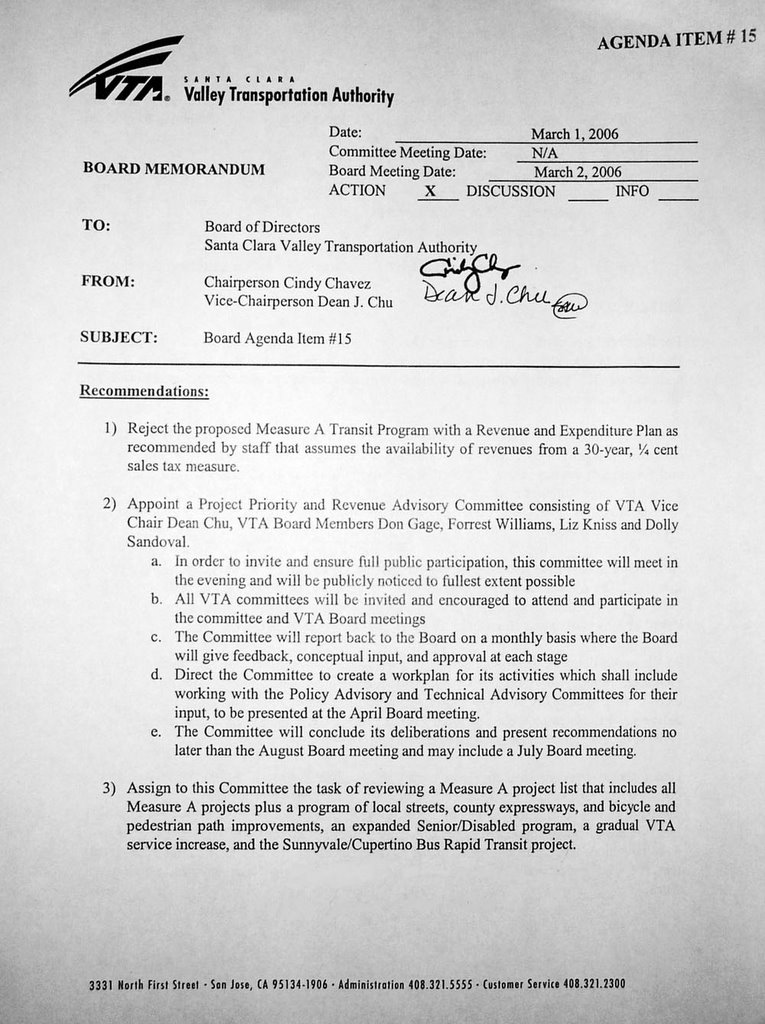
At the VTA board meeting on March 2, VTA Chair and San Jose Vice Mayor Cindy Chavez and Dean Chu from Sunnyvale presented a memo to reject the 1/4 cent tax scenario and establish a Measure A sub-commitee to start a "public" process to determine expenditure priorities. The sub-committee would complete its tasks and formulate recommendations to the VTA board no later than August, before the deadline to submit a ballot measure for the November election.

During the discussion, Supervisor Liz Kniss expressed appreciation for the memo and asked to hold the sub-committee meetings in different parts of the county. Supervisor Jim Beall, who is a candidate for the State Assembly, requested to hold one of the meetings in his district as well.

However, Forest Williams from San Jose complained that why he had to wait a few more months to make a decision after spending the last several months discussing the expenditure scenario. He seemed that he wanted to go ahead and immediately vote on the expediture plan despite the disagreements between the cities.

Greg Perry of Mountain View asked why the proposed sub-committee was not charged to study different tax revenue projections and why the members of that sub-committee were designated on the memo rather than letting the city groups to decide.

Dennis Kennedy of Morgan Hill suggested that the sub-committee should recommend an advisory measure at the end of its term in August and submit it for the November ballot.

Despite all the good intentions about public participation and creating a countywide consensus, it was obvious that this memo was produced to avoid a guaranteed divided vote on the 1/4 cent tax scenario, as well as linking the VTA expenditure plan with the June county tax, which could violate Prop. 218. Perhaps what Kennedy was not aware is that he unveiled the plan of Carl Guardino, which is having a general sales tax in June and a following advisory measure in November. It is basically a 1996 A/B sales tax measure without both appearing on the ballot at the same time. Both the general sales tax measure and the advisory measure require 50% voter approval.

While there's a potential that the committee would recommend something different than the expenditure plan that the VTA board rejected, the prospect of an advisory vote in November have damaged the process before it begins. It is clear that the SVLG is determined to deceive voters and circumvent the 2/3 voter requirement, which other counties in the Bay Area have no problems in meeting that requirement.

The board approved the recommendation outlined in the memo with Perry dissenting.

Friday, February 24, 2006

Serving mystery sales tax in the county building

Remember the last time being served mystery meat? This time the county is serving something that tastes just like mystery meat: mystery sales tax. This mystery sales tax has a simple recipe:

Shall a sales tax of one-half of 1 percent be enacted for general county purposes such as:
The county hospital and clinics;
Trauma and emergency services;
Affordable homes for families and seniors;
Health insurance for uninsured children;
Prevention programs for at-risk youth, families and seniors;
Transportation improvements approved in city and countywide transportation plans;
Services for abused and neglected children;
with a Citizens Oversight Committee to ensure fiscal accountability by reviewing the Annual Audit?

From the list above, can you answer these questions:

  1. Is there any guideline or assurance that any program mentioned would get the necessary funding?
  2. Is there any assurance for the county that it won't use the sales tax revenue for other unstated purposes?
  3. Is there any measure to protect social and geographical equity of the tax?

Carl Guardino was reportedly threatened the supervisors with opposing the 1/4 cent sales tax unless the county supports a 1/2 cent tax, along with a gentleman's agreement that half of the tax goes to Guardino's pet project: BART. Guardino and the county are refusing to admit this hidden agreement in order to sell this specific tax, which requires 2/3 voter approval, as a general fund tax, which requires 1/2 voter approval.

VTA Watch has earlier reported about the possibility of the county supporting transportation projects. With Guardino's recent influence, the currently proposed ballot measure could result in a worst case scenario, where the more than half of the new sales tax would go to the BART project without further input from voters.

While the county supervisors today may not want to spend the entire 1/4 cent, or a penny at all on BART, there will be turnovers on the board in the future that may change its spending priorities. Also, VTA could ask the county to pay for bus service with the county's new tax and then spend all the VTA's bus funding on BART. Unfortunately this proposal, which would make the sales tax in Santa Clara County highest in the state, offers no guideline nor protection against wasteful spending.