Recently, bus reroute brochures have appeared on many buses traveling through downtown San Jose. These brochures describe the temporary rerouting for the Rock and Roll Half Marathon in Downtown San Jose on October 8. The event requires the temporary closure of The Alameda and Santa Clara Street, among others.
Unlike the rerouting information provided for the San Jose Grand Prix. These rerouting brochures only contain the reroute descriptions in text, with no maps and graphics, and are photocopied rather than printed.
It was reported that the VTA had no prior knowledge of this event until sometime early last week when one of the VTA staffers visited the Marathon's web site. The VTA staff quickly drafted a rerouting plan and made it available to the public.
Although VTA's quick action has prevented a possible transit meltdown on the morning of October 8, it also highlights that the City of San Jose, which hosts the event, needs to work with VTA to plan around special events and to help market transit to participants. The Rock and Roll Marathon's web site contains no information on VTA, despite the fact that the light rail and some of the bus routes start operating early on Sundays, well before the 7:55am start of the race. The Bay to Breakers, on the other hand, provides extensive information on access by public transit online.
Wednesday, October 04, 2006


Monday, September 18, 2006
Why is having SOV hybrids on HOV lanes a bad idea
For a lot of people, their reason for supporting SOV hybrid cars on HOV lanes is simple: HOV lane is not crowded, hybrid cars are good for the environment and use less gas, then awarding the use of HOV lane provides an incentive to purchase more hybrid cars.
The reality is that allowing SOV hybrid on carpool lanes, not only defeating the purpose of carpool lanes, but is also a very regressive way to promote sustainable transportation.
Caltrans recently reported that the HOV lanes in the state are more crowded since last year, when DMV began distributing HOV access stickers to hybrid cars. Although other reasons, like higher employment rate, may have also contributed to the crowded lanes, the impacts from SOV hybrids can be significant and cannot be overlooked. Carpool lanes in Virginia are also clogged as a result of allowing SOV hybrids into HOV lanes.
When the carpool lane is clogged, the travel time savings by carpooling or taking express buses diminish and commuters are more likely to drive alone. The HOV lanes will then fail to meet their goal: deliver a higher people throughput than SOV lanes.
Many people that have purchased a hybrid recently cited access to HOV lanes is one of the reasons for buying one. Basically for an $8 registration fee to the DMV, they will get an unlimited use HOV "pass." Unlike those who take the time and effort to form a carpool, hybrid drivers don't have to change any commuting behaviors. All they have to do is to go to a Toyota or a Honda dealer and get on the waiting list to buy a car.
Obviously there is an economic value for the buyer to drive on HOV lanes without having to carpool. Whatever that economic value is, the state isn't getting any of it with a nominal $8 registration fee. On the other hand, hybrid car makers/dealers are selling these vehicles at a premium without having to spend their money to promote them. The car makers/dealers are profiting at the public's expense.
Allowing SOV hybrids on HOV lanes is also regressive and makes these lanes the ultimate "Lexus lanes." Unlike high occupancy toll (HOT) lane system that allows everyone to pay a much lower one time fee to use the lanes, drivers must make a high upfront payment to either purchase or finance a hybrid car in order to receive unlimited access on HOV lanes. Such an high upfront cost to obtain a hybrid is simply too expensive for low income folks who could only afford a used non-hybrid car.
Unfortunately, once this perk is given away, it is hard to take it back with a growing "constituency" of hybrid owners. The VTA General Manager Michael Burns is one of them. He reportedly drives a VTA-issued Toyota Prius with HOV stickers.
The reality is that allowing SOV hybrid on carpool lanes, not only defeating the purpose of carpool lanes, but is also a very regressive way to promote sustainable transportation.
Caltrans recently reported that the HOV lanes in the state are more crowded since last year, when DMV began distributing HOV access stickers to hybrid cars. Although other reasons, like higher employment rate, may have also contributed to the crowded lanes, the impacts from SOV hybrids can be significant and cannot be overlooked. Carpool lanes in Virginia are also clogged as a result of allowing SOV hybrids into HOV lanes.
When the carpool lane is clogged, the travel time savings by carpooling or taking express buses diminish and commuters are more likely to drive alone. The HOV lanes will then fail to meet their goal: deliver a higher people throughput than SOV lanes.
Many people that have purchased a hybrid recently cited access to HOV lanes is one of the reasons for buying one. Basically for an $8 registration fee to the DMV, they will get an unlimited use HOV "pass." Unlike those who take the time and effort to form a carpool, hybrid drivers don't have to change any commuting behaviors. All they have to do is to go to a Toyota or a Honda dealer and get on the waiting list to buy a car.
Obviously there is an economic value for the buyer to drive on HOV lanes without having to carpool. Whatever that economic value is, the state isn't getting any of it with a nominal $8 registration fee. On the other hand, hybrid car makers/dealers are selling these vehicles at a premium without having to spend their money to promote them. The car makers/dealers are profiting at the public's expense.
Allowing SOV hybrids on HOV lanes is also regressive and makes these lanes the ultimate "Lexus lanes." Unlike high occupancy toll (HOT) lane system that allows everyone to pay a much lower one time fee to use the lanes, drivers must make a high upfront payment to either purchase or finance a hybrid car in order to receive unlimited access on HOV lanes. Such an high upfront cost to obtain a hybrid is simply too expensive for low income folks who could only afford a used non-hybrid car.
Unfortunately, once this perk is given away, it is hard to take it back with a growing "constituency" of hybrid owners. The VTA General Manager Michael Burns is one of them. He reportedly drives a VTA-issued Toyota Prius with HOV stickers.
Wednesday, August 16, 2006
Clear cut fraudulent BART ridership projection (part 2)
Richard Mlynarik has provided a great analysis with the new ridership projection from VTA for the BART extension. You can enjoy a quick aerial photo tour of the proposed BART stations in the South Bay with actual stations in San Francisco and Berkeley, and see how out of touch VTA is.
From VTA Presentation Slide 13:
2025 projection:
Montague/Capitol 19247
Berryessa 6537
Alum Rock 9115
Civic Plaza/SJSU 6236
Market Street 17866
Diridon/Arena 9667
Santa Clara 14919
Total (7 stations) 83587
2030 projection (25% increase):
Montague/Capitol 31067
Berryessa 7931
Alum Rock 10639
Downtown San Jose [combined stop] 23439
Diridon/Arena 11209
Santa Clara 19842
Total (6 stations) 104127
Current exits in Downtown San Francisco:
Montgomery 31276
Embarcadero 31584
Powell 23272
Civic Center 18463
Now VTA is not only applying the ridership numbers from Downtown San Francisco to Downtown San Jose, but in Milpitas as well. So far, Milpitas isn't planning to become another Downtown San Francisco. Is VTA expecting a huge percentage of that ridership to transfer to and from light rail on their way to the Golden Triangle? If that is the case, shouldn't VTA be supporting ACE/Caltrain Metro East instead since it will serve the Golden Triangle directly without having to transfer?
For a more apples to apples like comparison, the ridership projection for Milpitas, Diridon, and Santa Clara stations should not be too different than Balboa Park, Richmond, and Millbrae. They are all non-downtown stations but with rail connections. We also shouldn't forget that Muni Fast Pass holders get to ride BART free within San Francisco, where Balboa Park is the City's southern most station.
Balboa Park 12251
Richmond 3251
Millbrae 3349
As expected, the projected ridership numbers are clearly meant to deceive.
From VTA Presentation Slide 13:
2025 projection:
Montague/Capitol 19247
Berryessa 6537
Alum Rock 9115
Civic Plaza/SJSU 6236
Market Street 17866
Diridon/Arena 9667
Santa Clara 14919
Total (7 stations) 83587
2030 projection (25% increase):
Montague/Capitol 31067
Berryessa 7931
Alum Rock 10639
Downtown San Jose [combined stop] 23439
Diridon/Arena 11209
Santa Clara 19842
Total (6 stations) 104127
Current exits in Downtown San Francisco:
Montgomery 31276
Embarcadero 31584
Powell 23272
Civic Center 18463
Now VTA is not only applying the ridership numbers from Downtown San Francisco to Downtown San Jose, but in Milpitas as well. So far, Milpitas isn't planning to become another Downtown San Francisco. Is VTA expecting a huge percentage of that ridership to transfer to and from light rail on their way to the Golden Triangle? If that is the case, shouldn't VTA be supporting ACE/Caltrain Metro East instead since it will serve the Golden Triangle directly without having to transfer?
For a more apples to apples like comparison, the ridership projection for Milpitas, Diridon, and Santa Clara stations should not be too different than Balboa Park, Richmond, and Millbrae. They are all non-downtown stations but with rail connections. We also shouldn't forget that Muni Fast Pass holders get to ride BART free within San Francisco, where Balboa Park is the City's southern most station.
Balboa Park 12251
Richmond 3251
Millbrae 3349
As expected, the projected ridership numbers are clearly meant to deceive.
Tuesday, August 08, 2006
The real Top 10 Questions for the BART project
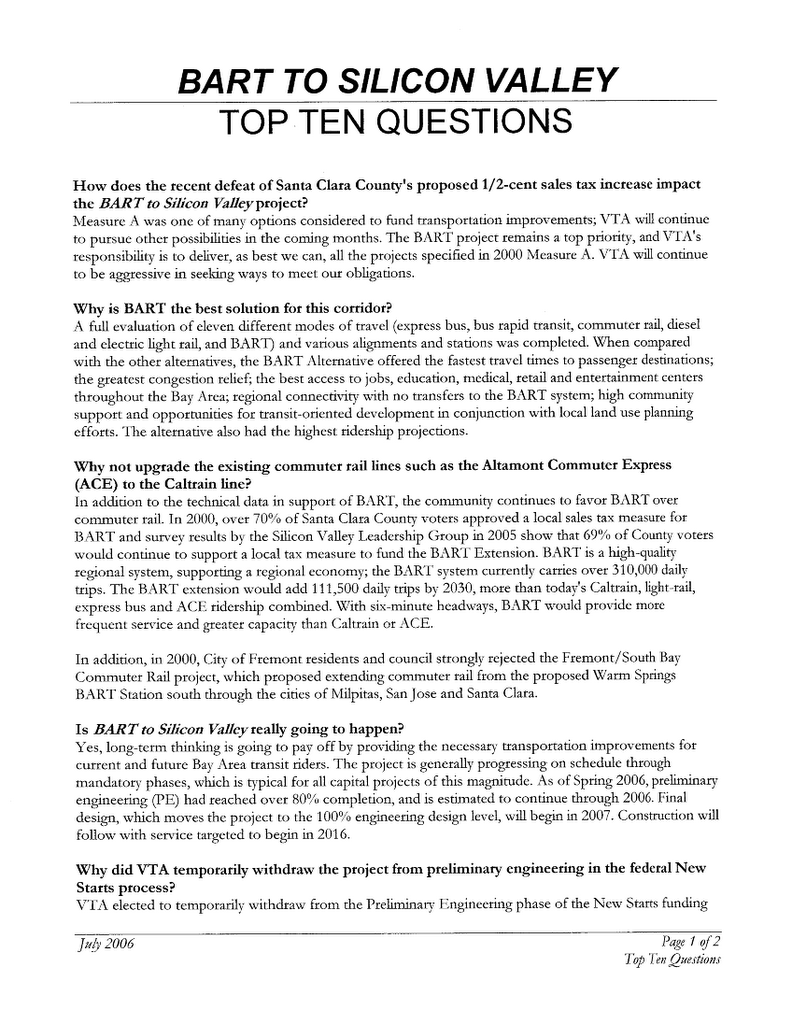
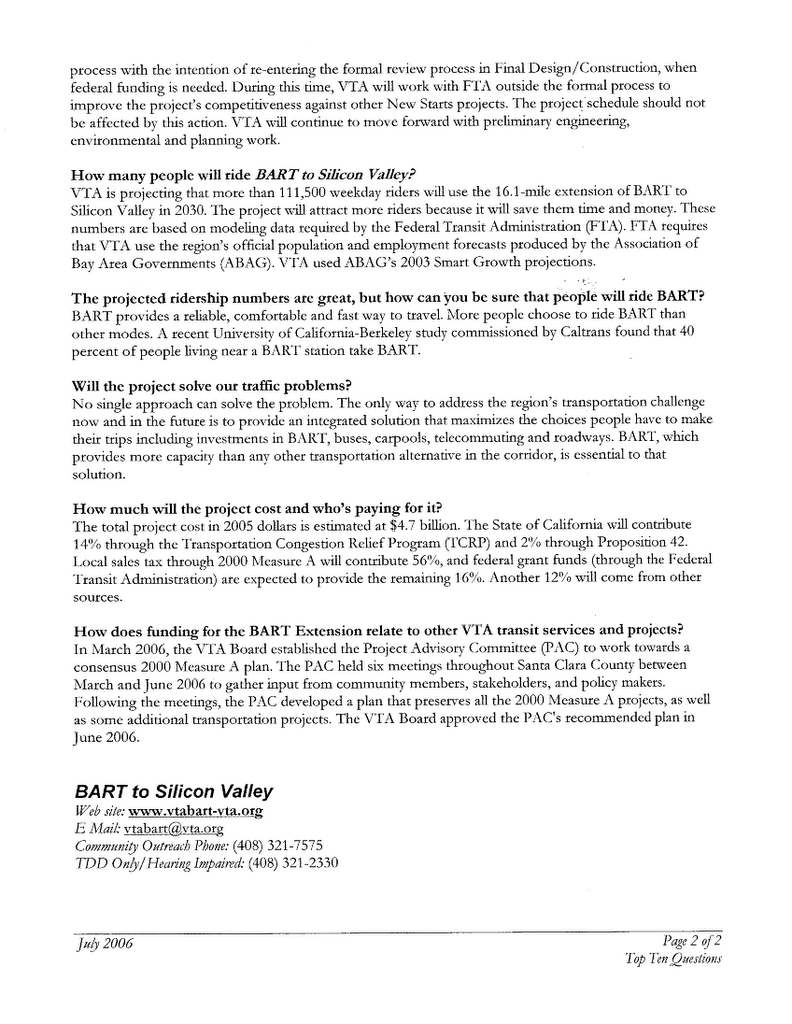
Click on the images for larger size
Instead of making another deceptive memo at the taxpayers' expense, VTA should be outright honest about the status of the BART project. If VTA's staff cannot do it right, VTA Watch will do it right for the sake of our taxpayers.
How does the recent defeat of Santa Clara County's proposed 1/2 cent sales tax increase impact the BART to "Silicon Valley" project?
VTA, along with SVLG and others, were counting on the 2006 Measure A to provide more funding to VTA. Instead of admitting the reality of voters' rejection of VTA's policy by denying more taxes to VTA, VTA is pretending nothing has happened with the hope that voters will pass another tax increase someday in the future. As the way it goes, VTA will continue to withhold a no-new-tax alternative as a way to pressure the voters to pass another tax; basically increase the tax for a lousy plan or increase the tax for a lousy plan.
Why is BART the "best solution" for this corridor?
BART is not the best solution for the corridor. The so call "full evaluation" was performed in 2001 with the full and clear bias for BART in a specific alignment and against any other modes and alignments. All VTA had to do was to somehow make up the ridership numbers and cost to make the pre-determined politically-driven plan to work.
Best access to jobs? It doesn't go to the job rich area bounded by 237, 101, and 880, the so called the "Golden Triangle." Sure, no transfers to the BART system, but not a transfer-less trip to where the jobs are. What about a direct Tri-Valley and possibly Altamont Pass connection, where it is rated as one of the most congested corridors in the Bay Area? Forget about it! Should this much taxpayer's money be spent on the BART extension that, for many Santa Clara County residents, means faster trips on transit to A's baseball games in Oakland?
Why not upgrade the existing commuter rail lines such as the Altamont Commuter Express (ACE) to the Caltrain line?
According to the 2000 Measure A, ACE upgrade is clearly listed as one of the projects eligible to receive Measure A funding. At that time, despite criticisms, Measure A supporters claimed there was enough funding that the BART extension would not be impacting the upgrade of the ACE line. Today, VTA, following the pre-June 6 SVLG talking points and outdated/misguided poll numbers, is saying that the 2000 Measure A is all about BART and nothing about ACE and everything else.
Due to the increasing slower freight train traffic, what ACE needs is a dedicated right of way to enhance speed and reliability. What VTA has is a dedicated right of way between Fremont and San Jose. Instead of giving ACE the use of a publicly owned right of way to improve reliability and increase ridership, VTA plans to leave it empty until the day when BART, which its tracks are 100% incompatible to ACE, is built.
The rail mode with no direct connection to the Tri-Valley and no connection over the Altamont Pass gets everything, and the one with direct connection to the Tri-Valley and the Altamont Pass gets nothing. Is it fair? Does VTA care?
Is BART to "Silicon Valley" really going to happen?
If you're one of the contractors and consultants working on the project and would receive millions of dollars of payment from it, you will want to believe it will happen. The federal government, which VTA will require approval from before receiving any federal funding for final design and construction, is questioning this project. Even if VTA has a new tax, it will not be a slam dunk.
Why did VTA temporarily withdraw the project from preliminary engineering in the federal New Starts process?
VTA withdrew the process knowing that the project will face certain rejection from the federal government, as this project would be evaluated along with other rail and bus expansion projects throughout the nation. Rather than facing a rejection, VTA was hoping to get back to the process next year if the 2006 Measure A is passed, which didn't happen. Even with a new tax, there is no guarantee that the federal government will approve it. VTA's financial plan and ridership projection for BART are as flawed whether there's a new tax or not.
How many people will ride BART to "Silicon Valley"?
VTA is projecting 111,500 daily riders, but it is a questionable projection. To put it into perspective, what VTA is projecting is about 1/3 of the total BART ridership today, which half of it is transbay ridership, a corridor that has limited highway competition (one toll bridge). In addition, VTA projection is the nearly the same as the Red Line subway in Los Angeles, a system with twice as many station and lower fares, and a city with the population many more times than in Santa Clara County. Finally, VTA's projection for the BART line is more than the entire VTA bus ridership today! In comparison, the bus system in Los Angeles carries 10 times more riders than the Red Line.
It is not the first time a BART extension uses questionable projection. The latest extension to SFO was built using phony projections and now SamTrans, who carries the responsibility of paying the operating subsidy, is now suffering from low BART ridership.
The projected ridership numbers are great, but how can you be sure that people will ride BART?
The statement "more people choose to ride BART than other modes" is balony beyond reason. People choose to ride transit because it goes where people want to go in a reasonble time and at a reasonable cost, regardless of how the train looks like or who operates it. Caltrain was able to increase its ridership by over 20% by offering express service. The ridership on the Orange Line (Bus rapid transit) in Los Angeles has grown beyond projection. Caltrain and Orange Line are not BART, but they're transit successes.
What made BART a success today is the high density urban growth in San Francisco, and the limited highway competition on the Bay Bridge. Neither case is true in Santa Clara County, but VTA expects the same number of boardings at a downtown San Francisco station to apply in downtown San Jose. As we all know, the airport's landing path is limiting the building heights in downtown San Jose.
Will the project solve our traffic problem?
According to MTC, the second and third most congested spots last year were on the I-580 in the Tri-Valley area. The BART extension, unlike ACE, will not provide any alternative to this growing corridor.
How much will the project cost and who's paying for it?
What VTA stated omits the financing cost. When that, and other costs, are accounted for, the cost will be in the range of $6 to 7 billion. The construction timing and method proposed by VTA for the BART projects require a large cash flow that VTA doesn't have without bonding. What is also not included is the 100%+ cost overruns that other BART extensions have experienced.
The BART extension simply is a new Bay Bridge East Span in the making, except that the politicians themselves cannot pass new taxes on you like bridge tolls. However, voters should not be pressured to pass a new tax if VTA runs out of money in the midst of digging a subway in downtown San Jose.
How does funding for the BART Extension relate to other VTA transit service and projects?
VTA has passed an expenditure plan, but it requires a new tax to be effective. Even so, the expenditure plan provides no guarantees and protection to the other projects. Over the years, VTA has consistently used inflated tax revenue projections to make false claims that all projects are funded, and VTA has consistently refused to consider other scenarios where no new taxes are needed and projects that can fulfill all of the 2000 Measure A goals and beyond. As long as BART is in VTA's plan, all other non-BART projects are essentially screwed.
Monday, July 31, 2006
Spare the Air free transit experiment
The free transit experiment, probably the largest in this country, is now over, after the first six days of Spare the Air days ended on July 21.
Some of the press reviews of the free transit days are critical. After all, the transit ridership went up by about 10%, and some regular transit riders complained about the crowding. Most of all it carries a heavy price tag of about $14 million.
To some of the transit supporters who advocates for free transit: there's the result.
The problem of providing free transit as a smog-reducing measure is that free transit has to be offered to everybody, not just commuters who regularly drive and take transit on Spare the Air days. Regular transit riders Spare the Air all the time and they pay a share of the transit operating cost. Giving regular transit riders free rides, while it could be justified in other ways, won't spare more air.
Another problem of free transit is that public transit is no longer only a transportation option, rather it becomes a public lounge space used by the homeless and others who have nowhere else to go, which drive away legitimate transit riders. Reports of alleged criminals using free transit is also disturbing.
The 10% increase in ridership can also highlight the relative inelasticity in transit demand in terms of fares as supposed to other factors like transit service improvements. In contrast, during the last two years, Caltrain was able to increase ridership by implementing the Baby Bullet service, despite having two fare increases.
However, regionwide free transit is a great marketing tool, especially in light of the very fragmented fare media in the Bay Area without Translink. Free fare removes the complexity of figuring out the fare, speed up bus service as passengers don't have to slowly feed dollar bills into the fare boxes, and allows low income riders to use more expensive rail service like BART and Caltrain for faster trips instead of local buses. Most importantly, free transit is like a trial offer as a way to increase the number of regular fare-paying transit riders who Spare the Air everyday rather than just on Spare the Air days. BART has reportedly seen an increase in fare paying riders after the free transit days.
Free transit has its values and its downsides. A free transit program should be designed in a way to encourage new transit rides that would translate into more fare paying riders after the program ends, and discourage free transit abuses.
Some of the press reviews of the free transit days are critical. After all, the transit ridership went up by about 10%, and some regular transit riders complained about the crowding. Most of all it carries a heavy price tag of about $14 million.
To some of the transit supporters who advocates for free transit: there's the result.
The problem of providing free transit as a smog-reducing measure is that free transit has to be offered to everybody, not just commuters who regularly drive and take transit on Spare the Air days. Regular transit riders Spare the Air all the time and they pay a share of the transit operating cost. Giving regular transit riders free rides, while it could be justified in other ways, won't spare more air.
Another problem of free transit is that public transit is no longer only a transportation option, rather it becomes a public lounge space used by the homeless and others who have nowhere else to go, which drive away legitimate transit riders. Reports of alleged criminals using free transit is also disturbing.
The 10% increase in ridership can also highlight the relative inelasticity in transit demand in terms of fares as supposed to other factors like transit service improvements. In contrast, during the last two years, Caltrain was able to increase ridership by implementing the Baby Bullet service, despite having two fare increases.
However, regionwide free transit is a great marketing tool, especially in light of the very fragmented fare media in the Bay Area without Translink. Free fare removes the complexity of figuring out the fare, speed up bus service as passengers don't have to slowly feed dollar bills into the fare boxes, and allows low income riders to use more expensive rail service like BART and Caltrain for faster trips instead of local buses. Most importantly, free transit is like a trial offer as a way to increase the number of regular fare-paying transit riders who Spare the Air everyday rather than just on Spare the Air days. BART has reportedly seen an increase in fare paying riders after the free transit days.
Free transit has its values and its downsides. A free transit program should be designed in a way to encourage new transit rides that would translate into more fare paying riders after the program ends, and discourage free transit abuses.
Thursday, July 27, 2006
Light rail station reopened for Grand Prix
VTA reopened the Paseo de San Antonio light rail station yesterday in time for the Grand Prix. A small ceremony was held next to the Repertory Theatre to cerebrate the reopening. After speeches made by the VTA Chair Cindy Chavez, as well as representatives from the VTA Committee for Transit Accessibility, San Jose Downtown Association, and San Jose State University, a special light rail train arrived at the platform on 2nd Street, and passengers with a baby stroller, bicycle, and unicycle, along with passengers in wheelchairs, exited the vehicle and the station with having to navigate any steps.
Unlike all other stations, the new platform is actually consisted of three smaller platforms matching the door locations of each car. The Downtown Association strongly advocated this design as a way to maintain pedestrian access in the area. In constrast to the original design of a large platform, there is enough space between the small platforms where the bus stops can be placed back near their original locations, thus the cross-platform access between the bus and the light rail is maintained.
Although the station was reopened early, the station is not yet completed. Granite pavers and benches were installed only on two of the three small platforms at each location. The third small platforms instead have plywood coverings to support three car trains for the anticipated Grand Prix crowd. Also, there was no shelter or any type of overhead covering installed.
Unlike all other stations, the new platform is actually consisted of three smaller platforms matching the door locations of each car. The Downtown Association strongly advocated this design as a way to maintain pedestrian access in the area. In constrast to the original design of a large platform, there is enough space between the small platforms where the bus stops can be placed back near their original locations, thus the cross-platform access between the bus and the light rail is maintained.
Although the station was reopened early, the station is not yet completed. Granite pavers and benches were installed only on two of the three small platforms at each location. The third small platforms instead have plywood coverings to support three car trains for the anticipated Grand Prix crowd. Also, there was no shelter or any type of overhead covering installed.
Friday, July 07, 2006
San Jose Grand Prix and Light Rail
With the Grand Prix race track crossing the VTA light rail tracks in two different locations, the VTA light rail system will be split in more than two pieces during the Grand Prix weekend.
On Friday, July 28, the lines from Alum Rock and Mountain View both end in downtown San Jose, and the line from Santa Teresa will have through routing to Winchester. Like last year, a bus bridge will connect the two light rail segments in downtown San Jose.
The fun part begins on Saturday, July 29, through Sunday. The line from Mountain View will end at Baypointe, and passengers will have to transfer light rail from Alum Rock to downtown San Jose. Like last year, the line from Santa Teresa will only be partially rerouted to the new Vasona line and end at San Jose Diridon station. Service from Winchester will end at Race station, one stop south of San Jose Diridon. Passengers from the Winchester line will have to transfer to a bus to downtown San Jose and connect with other light rail lines.
Normally a system with two main lines through downtown San Jose will be cut into four pieces and the plan will add a great deal of confusion among all light rail riders. For those from Los Gatos and Campbell, this means that they won't be able to take light rail directly to the race track on the Grand Prix weekend.
In its publicity materials, VTA didn't specify any reason to cut the Mountain View line back to Baypointe or cut the service from Winchester away from downtown San Jose, and VTA also did not explain whether additional light rail service would be provided on the Grand Prix weekend.
According to the plan, it is speculated that three car trains will be used throughout on the Santa Teresa line on the weekend. Along the new Vasona extension, only San Fernando and Diridon stations can accomodate three car trains. All platforms south of the Diridon station are one car length shorter than other stations. By ending the service from Winchester to the Race station, it seems that VTA is planning to isolate the less frequent one/two car-service with the more frequent three-car mainline service from Santa Teresa.
In addition, VTA has indicated in its documents that the Paseo de San Antonio station will be in service for the Grand Prix. When VTA closed the station for construction in February, VTA planned to reopen in October. Due to the criticisms and pressures from local businesses and San Jose State, VTA internally accelerated the construction schedule.
On Friday, July 28, the lines from Alum Rock and Mountain View both end in downtown San Jose, and the line from Santa Teresa will have through routing to Winchester. Like last year, a bus bridge will connect the two light rail segments in downtown San Jose.
The fun part begins on Saturday, July 29, through Sunday. The line from Mountain View will end at Baypointe, and passengers will have to transfer light rail from Alum Rock to downtown San Jose. Like last year, the line from Santa Teresa will only be partially rerouted to the new Vasona line and end at San Jose Diridon station. Service from Winchester will end at Race station, one stop south of San Jose Diridon. Passengers from the Winchester line will have to transfer to a bus to downtown San Jose and connect with other light rail lines.
Normally a system with two main lines through downtown San Jose will be cut into four pieces and the plan will add a great deal of confusion among all light rail riders. For those from Los Gatos and Campbell, this means that they won't be able to take light rail directly to the race track on the Grand Prix weekend.
In its publicity materials, VTA didn't specify any reason to cut the Mountain View line back to Baypointe or cut the service from Winchester away from downtown San Jose, and VTA also did not explain whether additional light rail service would be provided on the Grand Prix weekend.
According to the plan, it is speculated that three car trains will be used throughout on the Santa Teresa line on the weekend. Along the new Vasona extension, only San Fernando and Diridon stations can accomodate three car trains. All platforms south of the Diridon station are one car length shorter than other stations. By ending the service from Winchester to the Race station, it seems that VTA is planning to isolate the less frequent one/two car-service with the more frequent three-car mainline service from Santa Teresa.
In addition, VTA has indicated in its documents that the Paseo de San Antonio station will be in service for the Grand Prix. When VTA closed the station for construction in February, VTA planned to reopen in October. Due to the criticisms and pressures from local businesses and San Jose State, VTA internally accelerated the construction schedule.
Friday, June 23, 2006
Gonzales' culture of corruption may well extend beyond the City Hall
Like anyone being arrested, a fair question comes up whether the person has violated the law for the first time, or has violated many times but did not get caught. In the case of the San Jose Mayor, his style of backroom deals that contributed to his arrest yesterday certainly raises concerns about the possibility of other secretive deals inside and outside of the City Hall, such as at the VTA, where he has a strong influence and a flawed agenda.
Monday, June 12, 2006
Sales tax extortion scheme
VTA remains defiant despite the failure of Measure A. This Thursday, the VTA board will decide whether to adopt a spending plan that assumes a new 1/4 cent sales tax or equivalent.
Since the BART extension has been withdrawn from the federal new-starts process last December, the failure of Measure A last week indicates that the BART project will likely to remain off the new-starts process to avoid the guaranteed rejection from the federal government. However, it also allows VTA to spend as much as it wants on studies and engineering efforts that may not translate into completion of the project.
The BART extension has many similarities to the Bay Bridge East Span fiasco, where politicians shut-off discussion about cost effective alternatives early in the process in favor of a costly design that does not provide any functional improvements. Last year, when the construction bid for the single tower structure came out much higher than originally estimated, the politicians determined that it was too late to redesign the bridge and provide significant cost savings. Instead, without having to go to the voters, politicians approved a bailout package that will increase the bridge tolls effective next year.
It appears that Guardino and Gonzales are going through the same route by spending more local tax dollars on studies and design until when choosing another alternative would be seen as unfavorable. However, Guardino and Gonzales cannot raise sales taxes without the approval of voters.
VTA is on the path to extort taxpayers' money, by spending more money on things that cannot happen until voters approve another tax increase. VTA does not have to be on this path if it chooses to pursue real studies and live within its means.
Since the BART extension has been withdrawn from the federal new-starts process last December, the failure of Measure A last week indicates that the BART project will likely to remain off the new-starts process to avoid the guaranteed rejection from the federal government. However, it also allows VTA to spend as much as it wants on studies and engineering efforts that may not translate into completion of the project.
The BART extension has many similarities to the Bay Bridge East Span fiasco, where politicians shut-off discussion about cost effective alternatives early in the process in favor of a costly design that does not provide any functional improvements. Last year, when the construction bid for the single tower structure came out much higher than originally estimated, the politicians determined that it was too late to redesign the bridge and provide significant cost savings. Instead, without having to go to the voters, politicians approved a bailout package that will increase the bridge tolls effective next year.
It appears that Guardino and Gonzales are going through the same route by spending more local tax dollars on studies and design until when choosing another alternative would be seen as unfavorable. However, Guardino and Gonzales cannot raise sales taxes without the approval of voters.
VTA is on the path to extort taxpayers' money, by spending more money on things that cannot happen until voters approve another tax increase. VTA does not have to be on this path if it chooses to pursue real studies and live within its means.
Friday, June 09, 2006
The high price of working with Carl Guardino
The 2000 Measure A Project Advisory Committee held its last meeting yesterday in Mountain View.
VTA's general manager Michael Burns argued that the committee should pass the revised expenditure scenario with the assumption of a new 1/4 cent tax, and said that VTA still have the option of placing a sales tax in November or in 2008. The committee approved the revised scenario, which prioritized some of the non-BART projects ahead of the BART extension. Despite the approval, the sales tax scenario is unworkable because voters rejected the 2006 Measure A.
During the meeting, two of the county supervisors (Kniss and Gage) on the committee, as reported by some in the audience, looked "mad," given their support for the 2006 Measure A and its defeat on Tuesday.
The county supervisors had a chance to place a 1/4 cent general sales tax only for county services, without diverting funds to VTA. Instead of listening to the transit advocates, the Supervisors chose to listen to Carl Guardino and place a dual sales tax instead.
In an email sent on January 25, Guardino wrote: "The county would need a very well funded campaign, and would need a very poorly funded and poorly organized opposition campaign, in order to be successful," and Guardino concluded, "Interestingly, if the county and the transportation advocates worked together - even though the total (a combined half-cent) would be the same as two competing quarter-cent measures - the chances of winning are very strong."
After outspending the opposition by nearly 100 to 1, voters resoundingly rejected Measure A, defying Guardino's expectation. With the restriction from Prop. 218, the next time the county could place a general tax is June 2008, or in November this year if the county declares a fiscal emergency.
It is unfortunate that the county services may be impacted by the failure of Measure A. The supervisors will be paying a high price for listening to Carl Guardino.
VTA's general manager Michael Burns argued that the committee should pass the revised expenditure scenario with the assumption of a new 1/4 cent tax, and said that VTA still have the option of placing a sales tax in November or in 2008. The committee approved the revised scenario, which prioritized some of the non-BART projects ahead of the BART extension. Despite the approval, the sales tax scenario is unworkable because voters rejected the 2006 Measure A.
During the meeting, two of the county supervisors (Kniss and Gage) on the committee, as reported by some in the audience, looked "mad," given their support for the 2006 Measure A and its defeat on Tuesday.
The county supervisors had a chance to place a 1/4 cent general sales tax only for county services, without diverting funds to VTA. Instead of listening to the transit advocates, the Supervisors chose to listen to Carl Guardino and place a dual sales tax instead.
In an email sent on January 25, Guardino wrote: "The county would need a very well funded campaign, and would need a very poorly funded and poorly organized opposition campaign, in order to be successful," and Guardino concluded, "Interestingly, if the county and the transportation advocates worked together - even though the total (a combined half-cent) would be the same as two competing quarter-cent measures - the chances of winning are very strong."
After outspending the opposition by nearly 100 to 1, voters resoundingly rejected Measure A, defying Guardino's expectation. With the restriction from Prop. 218, the next time the county could place a general tax is June 2008, or in November this year if the county declares a fiscal emergency.
It is unfortunate that the county services may be impacted by the failure of Measure A. The supervisors will be paying a high price for listening to Carl Guardino.
Subscribe to:
Posts (Atom)


 Posts
Posts


